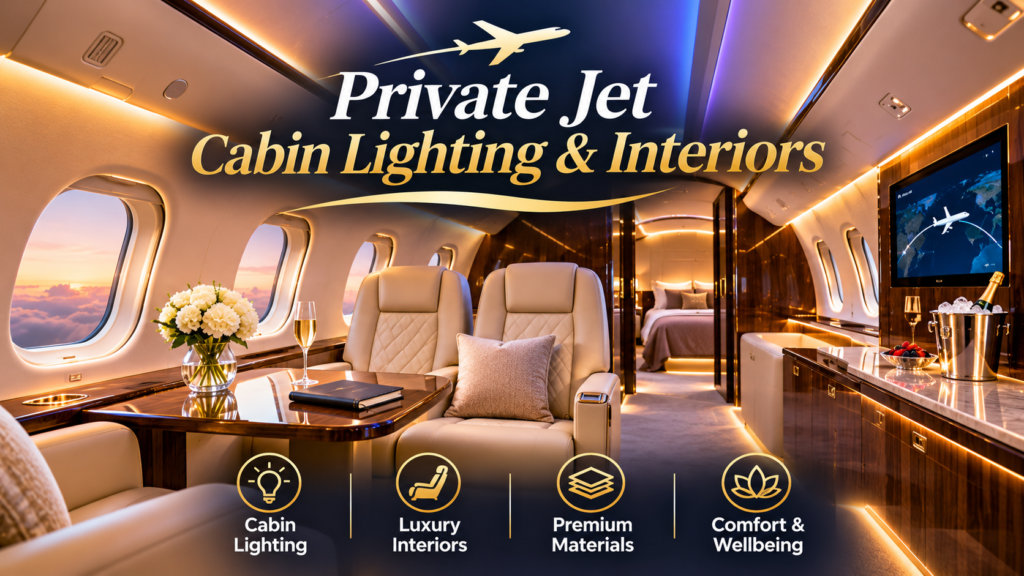
The first thing most people notice on boarding a private jet is not the size of the cabin. It is the light. A luxury private jet charter cabin is lit the way a good hotel room is lit: softly, in layers, with the brightness and colour matched to the time of day and the mood of the flight. That is deliberate. On a flight of several hours, lighting, materials and layout shape how rested you feel on arrival, and the best cabins are designed with that in mind from the start.
Interiors vary enormously between aircraft, and the differences are not only about taste. A light jet and a large-cabin jet are different worlds in terms of headroom, width, seating and what the galley can do. Understanding what varies, and why, helps you choose the right aircraft for the trip, and ask the right questions before you book.
Cabin lighting, and why it matters more than it looks
Cabin lighting in a modern jet is almost entirely LED, divided into zones that can be controlled separately. The main cabin, the galley, the lavatory and individual reading lights each run on their own settings, and the crew can dim the whole cabin for sleeping while keeping a work area lit. Colour temperature matters too: cooler white light suits working and meal service, while warmer tones suit evening flying and winding down. Small details, like lighting under seats and along the floor, make the cabin easier to move around in at night without waking anyone.
Good lighting design also flatters the materials around it. Wood veneers, leather and metal trims all respond differently to light, and cabin designers choose finishes with the lighting scheme in mind. A cabin that looks flat and harsh under bright light will feel gloomy when dimmed, while a well-designed one stays warm and readable at every setting. It is one of those things you only notice when it is wrong.
Circadian lighting on long routes
On long flights, some newer large-cabin jets offer circadian lighting, which shifts colour temperature and brightness through the flight to match the destination’s time zone. The idea is simple: light is the strongest signal the body uses to set its internal clock, so a cabin that mimics morning light before arrival can make the first day at the destination easier. If you are chartering a luxury private jet for a long overnight sector, it is worth asking the operator in advance whether the aircraft offers this, since not every aircraft does, and the benefit depends on the route and the schedule.
Circadian lighting is not magic, and it will not remove jet lag on its own. It works best combined with the other things that help on long flights: sleeping when the destination is asleep, eating at destination times, and arriving hydrated. But on a seven-hour overnight sector, a cabin that wakes you gently with rising light beats a cabin where the crew switches on full brightness an hour before landing.
Materials, layout and aircraft size
Materials set the tone of a cabin more than any single feature. Leather seating is standard across most of the market, but the quality, stitching and padding vary, and the difference shows after a few hours. Wood veneers, metal trims, wool carpets and stone or composite surfaces in the galley and lavatory all contribute, and the best cabins use them quietly rather than loudly. Sound insulation matters as much as the visible finishes: a quiet cabin is the difference between working comfortably and shouting over engine noise.
Layout follows aircraft size. Light jets typically seat four to six passengers, with limited headroom and no separate lavatory in the smallest types. Midsize and super-midsize jets add a stand-up or near stand-up cabin, a proper lavatory and more baggage space. Large-cabin jets offer a full stand-up cabin, a galley that can prepare hot meals, a bed or a fully flat divan, and on the largest types a shower. The right choice depends on the length of the flight, the number of passengers and whether anyone needs to sleep.
Seating configuration deserves a question of its own. Club seating, with four chairs facing each other, suits meetings and conversation. Forward-facing seats suit passengers who want to work or sleep. A divan can serve as a bed, and some aircraft offer a dedicated bedroom in the rear. If the trip involves work, sleep or a mix of both, say so when booking, because the layout that suits one does not always suit the other.
What luxury private jet charter cabins get right on long routes
Long routes expose every weakness in a cabin, and the good ones are built around three things: air, noise and space. Newer large-cabin jets hold a lower cabin altitude than older aircraft, which means more oxygen in the cabin and less fatigue on arrival. Better insulation and quieter engines keep noise down, so conversation and sleep come more easily. And space, real space to stand, stretch and move, keeps a seven-hour flight from feeling like a sentence.
Connectivity is now part of comfort too. Most large-cabin jets offer Wi-Fi, though speed and reliability vary by system and by where the aircraft is flying, and some routes have dead spots. If work on the flight matters, ask what system the aircraft carries and what it can realistically do. A cabin that lets you work properly for six hours and sleep for one is worth more than a larger cabin with no connection at all.
What to ask before you book
Before booking, ask for the cabin dimensions, the seating layout, the bed arrangement if anyone needs to sleep, and what the galley can actually serve. Ask about Wi-Fi, baggage space and whether the aircraft has circadian lighting if the flight is overnight. Photographs help, but dimensions and layout tell you more than pictures do, and a good operator will answer all of it without hesitation.