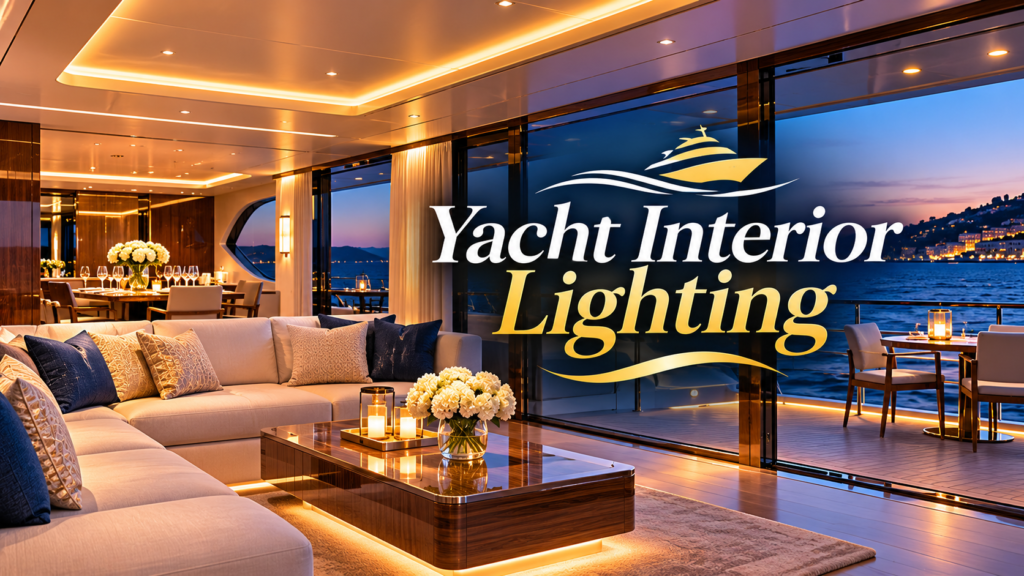
A luxury yacht charter is sold on space, water, and freedom, but what guests remember at the end of the week is often the light. The way the saloon glows in the evening. The way the deck stays usable long after sunset. The way a cabin feels at midnight, when the only light is the one you chose. Lighting design shapes all of that, and on a yacht it has to work harder than it does on land, because the same space serves as a dining room, a lounge, a cinema, and a place to read, sometimes all in one evening.
Good yacht lighting is rarely noticed, and that is the compliment. Bad lighting is noticed immediately: a saloon that feels like an office, a cabin where you cannot read without waking your partner, a deck where the glare kills the view of the stars. The difference is rarely money. It is design, and it comes down to layers, control, and colour.
Deck lighting: working light that stays out of the way
On deck, lighting has two jobs that pull in opposite directions. It has to be bright enough for safe movement, for dinner, and for the crew to work, and it has to be dim enough that the night stays dark and the stars stay visible. The answer is layers: low step lights on stairs and thresholds, soft wash lights under handrails and overhangs, and focused lights over dining tables that can be dimmed or switched off once the plates are cleared. The best deck lighting lets you walk the full length of the boat at midnight without a torch and without squinting.
Colour matters as much as brightness. Warm white light, around the colour of a candle or a domestic lamp, suits evenings on deck and flatters both food and faces. Cool white light feels clinical and belongs in workspaces, not dining areas. Most modern yachts use LED throughout, which makes it easy to tune the colour and the brightness for each area, and easy for the crew to set scenes: dinner, drinks, late night, early morning. Charter companies such as MyOcean know guests judge a boat in the first evening, and lighting does much of that work quietly.
Cabin lighting: layers, dimmers, and reading light
A cabin needs at least three kinds of light, and they should all be controllable from the bed. General light for dressing and packing. Soft ambient light for winding down. And a proper reading light for each side of the bed, aimed so it lights the book and not the whole cabin. The reading light is the detail that separates a well-designed cabin from a careless one. If both people cannot read, or sleep, independently, the lighting has failed at its simplest job.
Dimmers are not a luxury on a yacht. They are how one room serves four purposes. A saloon that can go from bright morning light to a low evening glow without switching circuits feels larger and calmer than one with a single harsh setting. Blackout blinds or curtains matter just as much, because a cabin that cannot be made properly dark at noon will not give anyone a good night’s sleep after a late evening on deck.
Underwater lights and the evening swim
Underwater lights have become standard on modern charter yachts, and they change the evening completely. Switched on after dark, they turn the water around the stern into a lit pool, and within minutes small fish arrive to feed in the glow, followed sometimes by larger visitors. It is one of the few features on a yacht that reliably delights adults and children equally, and it costs the crew nothing but a switch. The lights also make a night swim safer, because the swimmer stays visible from the deck.
There are practical limits. Underwater lights draw power, so on a yacht at anchor the crew will run them for a few hours in the evening rather than all night, and they will switch them off if the generator needs a rest. They also need clean lenses to work well, which is a small maintenance job that tells you something about how the boat is kept.
Lighting and mood on a luxury yacht charter
Mood is the word designers use, but on a charter it means something simple: does the boat feel right at nine in the evening? The answer comes from dozens of small decisions. Warm light in the saloon and cool light nowhere near it. Table lamps and floor washers instead of ceiling spots. Lights that dim smoothly instead of jumping between settings. Candles, real or LED, on the dining table. A dark flybridge for stargazing, with just enough light to find the steps. None of this is complicated. All of it needs someone to have thought about it before the guests arrived.
What to look for on a viewing
If you are viewing a yacht before booking, look at the lighting in daylight and ask to see it at night, or at least ask the crew to run through the evening scenes. Try the dimmers in the saloon and the cabins. Check the reading lights from the bed. Walk the decks in low light and see whether the steps are lit. Ask about underwater lights and when they are used. Look for glare: bare bulbs, unshielded spots, and reflective surfaces that throw light where it is not wanted. A boat lit with care feels calm and finished.
Lighting will not be the reason you choose a yacht, and it should not be. But it will be part of the reason the week feels the way it does, every single evening, and it is one of the easiest things to check before you commit. Ask the questions, run the dimmers, and pay attention to how the boat feels when the sun goes down. That feeling is the charter.